"Must have excellent inter-personnel skills and have the ability to communicate with a wide range of people in sometimes difficult situations."
"Ability to competently jump from one task to another whilst being in control and work under pressure" - people with Asperger are typically good at starting on a task, focussing on it and seeing it through, but don't feel very "in control" in the situation described above.
Tuesday, 5 May 2009

Wednesday, 15 April 2009
Ringaround of employers for Asperger awareness
The guy doing the "Flexible Routeways" had a ringaround of 8 employers of different types about what they would do if they had employed or were about to consider employing someone with Asperger. He's just e-mailed me about his findings, with only 2 of those contacted fully aware of Aspergers. The others were happy to listen and agreed the potential benefits far outweighed the negatives. In some cases, it was thought that extra time which the companies didn’t have would be needed to give help and assistance to a person with Aspergers, after explaining only the normal about of induction time was needed things became clearer, the only main adjustment being to reallocate substantial amounts of face-to-face and telephone contact with customers and suppliers to a colleague with better ability on that count.
Thursday, 9 April 2009
Interview feedback - not optimistic
Not optimistic about the interview unfortunately. Before going I felt boosted that I had got the interview as my outgoing letter had already said "I would finally make you aware that I do have a moderate condition of Asperger's Syndrome, so would not be well suited to customer or supplier contact", and I was pleased they were interviewing me in apparent full awareness of this.
However a few questions into the interview I got "How are you at dealing with awkward customers?" I referred back to the letter and the interviewer admitted that she hadn't noticed this part, and didn't know what Asperger was. I was asked because the "small family run business", really is that small, it is just father and daughter and the new person, and on two days of most weeks they would be out of the office a lot leaving the new person to work alone, thus being the lone face and voice of the company.
What got to me most about this is that as jobseekers we are constantly reminded to prepare by finding out about companies so they can ask "What do you know about us?". Yet on this occasion they hadn't prepared as they clearly overlooked that sentence in my letter.
Tuesday, 7 April 2009
First interview in six months
Had an e-mail back from a marquee hire company where I'd applied for a position doing admin and invoicing. I have an interview this coming Thursday 9th, its the first one I've had since the electricians' place in October.
Tuesday, 24 March 2009
Flexible Routeways review played on my mind
Last week’s weekly review conversation on the "Flexible Routeways" has really played on my mind for the past week to the extent that I have felt the need to put together a detailed response to address points that are difficult to address in the meetings due to time constraints etc. It is already appreciated at the provider that the main difficulty I have with job searching is the constantly stated requirements in job specifications for “good/excellent communication skills” when I am only ever at best “reasonable” given my disability of Asperger syndrome and consequentially hesitant, softly toned voice (i.e. not “confident” / “assertive” etc).
The caseworker had often told me to “leave previous employers’ criticisms in the past and tell myself I’m good”, I felt this was inappropriate as besides being easier said than done in principle, the implication is that the onus is on me to take a job with such specification, “tell myself I’m good” and learn to do the communication expected of someone with no disability, without any onus on the employer to make reasonable adjustments. I do realise (though that is no “consolation”) that the economic climate is allowing the employers to be more choosy than usual.
- I cannot simply “leave previous employers’ criticisms in the past”, as I concede:
- it was my fault I hadn’t told two of the employers in question that I had any named disability
- their criticisms, whilst undiplomatic (and may have been put more diplomatically if I had stated my named disability), were truthful in that I clearly do not have a normal “good” standard of communication skills and would not be able to do everything expected of someone who did.
I appreciate his positive comment that I compared favourably to people he worked with at another training provider where many less intelligent jobseekers were sent by the jobcentre in that I spoke “understandably” to himself, other staff and a visiting trainee nurse, though these were mainly conversations about my disability and the obstacles it causes with job searching where I am speaking from experience. However the employers in question would have had better communicators to compare me to, therefore I concede I did not compare so favourably to these, unlike for the caseworker considering his previous clients.
On the basis of the conversations referred to in the last paragraph he believed that I’d always be fine at one-to-one or small group communication with internal colleagues, I on occasions said “not all the time every time”, and had begun to quote an example from a period with a previous employer only to be cut off with the “that’s in the past leave it there” line. The example in question was that I'd been in a department with many complicated funding rules to learn which in that full role, I had responsibility for re-iterating to relevant staff when they did anything not compliant these rules. This was a “one-to-one communication” but I didn’t always do it perfectly, I couldn’t always get my head round the rules myself let alone explain to someone else. I do believe I am reasonable at internal communication most of the time, but quote the above to highlight not always. The caseworker is keen to contact prospective employers “to find out precise specifications of jobs” to establish whether references to “communication skills” refer to internal (I’d probably be alright but bear the above in mind) or customers and suppliers (definitely not suitable as I’ve already had proven bad experience).
I printed this out in a feedback letter to him, on the reverse of which I have printed a page of the National Autistic Society’s leaflet “Employee Pack - Looking for a Job” which actually cites a few examples of reasonable adjustments that could be applied to someone with Asperger, which may be helpful to him in contact with employers. In a similar situation to the above I feel that the employer would have to make the adjustment of ensuring that if there were similarly complicated issues that had to be regularly explained to internal staff, if I would find this difficult verbally, then the issues should be written down and perhaps re-iterated verbally by a more assertive natured colleague or supervisor.
Wednesday, 11 February 2009
Asperger Employment Documentary to be made
On one of the asperger forums someone from a film company has posted about how they are working to produce a documentary about adults with Aspergers finding employment, as so many focus only on children or a 'special ability'.
So often the media like to bash unemployed people tarring them all with the "chav" brush, and its time something was made to counter with the plight of those with much intelligence and skills to offer but largely unable to sell themselves in interviews.
So often the media like to bash unemployed people tarring them all with the "chav" brush, and its time something was made to counter with the plight of those with much intelligence and skills to offer but largely unable to sell themselves in interviews.
Sunday, 8 February 2009
Potentially discriminating restaurant design
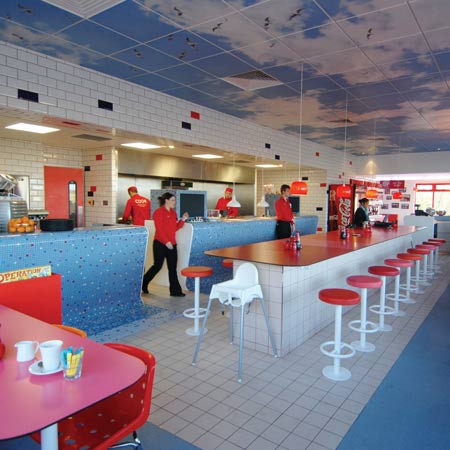
One well known roadside restaurant chain which I have often used since I have been a driver, has not been doing so well in recent times. Despite this they had a mixture of 4-8 seat tables for families, and two seat ones which I have felt comfortable to use. However, enter a well known TV chef and an appointed designer, the designers decide to have "communal tables" for those on their own, pictured:

This long table appears to have 9 seats each side, 18 in total. I would feel really uncomfortable with this, and my burning question is could this be seen as a discrimination against someone with Aspergers and similar who would feel discomfort at being made to sit at such a table? I'm sure that wasn't deliberately intented but have they really thought how someone with such a condition would find this intimidating? The chain's online news archive
Links to full article on Dezeen.com and the chain's archive, see the 'Big News' dated 28 November 2008.
This long table appears to have 9 seats each side, 18 in total. I would feel really uncomfortable with this, and my burning question is could this be seen as a discrimination against someone with Aspergers and similar who would feel discomfort at being made to sit at such a table? I'm sure that wasn't deliberately intented but have they really thought how someone with such a condition would find this intimidating? The chain's online news archive
Links to full article on Dezeen.com and the chain's archive, see the 'Big News' dated 28 November 2008.
Subscribe to:
Posts (Atom)